 RSS Feed
Equipment / Tools / Materials:
- Tape measure
- Full-length mirror
- Catch-all basket
- Shopping Bags
Step #1: Empty Out Your Closet
If you're used to shoving clothes into your closet, this is going to be weird, because you're about to take everything out and probably find some stuff shoved in a back corner that you forgot about. Remove everything from the closet, including hangers, baskets, bins, and anything else that might be on the floor or shelves.
Step #2: Deep Clean Your Closet
You need a clear, clean space to plan and visualize how you're going re-organize your closet. First, dust the shelving and hanging rods. Next, run the vacuum or sweep and mop the floor. Finally, wipe the shelving, hanging rods, walls, and baseboards down with a good all-purpose cleaner. Don't forget any baskets or bins that could be collecting dirt and dust.
Now comes the part you've either been looking forward to or dreading. Some people fear decluttering because they love to hold onto things they "may need one day" or "used to fit/be in style." Focus on what to keep rather than what you're getting rid of. Start by separating your clothes into four distinct piles:
- Keep: Anything you love and wear often.
- Consign: In order to sell or consign items, your clothing, shoes and accessories must be in good shape. Most consignment stores prefer them to be name brands.
- Donate: These items should be in good shape. Think "gently used" when adding to this pile.
- Trash: Clothing to trash would include anything stained beyond repair, ripped, hopelessly out of style or anything that you would be embarrassed to donate.
When you're trying to decide whether or not to keep something, it's helpful to ask yourself these questions:
- Do you love it?
- Do you wear it?
- Does it project the image you want to portray?
If the answer is "yes" to all three, then you can confidently place that item into the Keeper pile.
Step #4: Install Closet Organizers
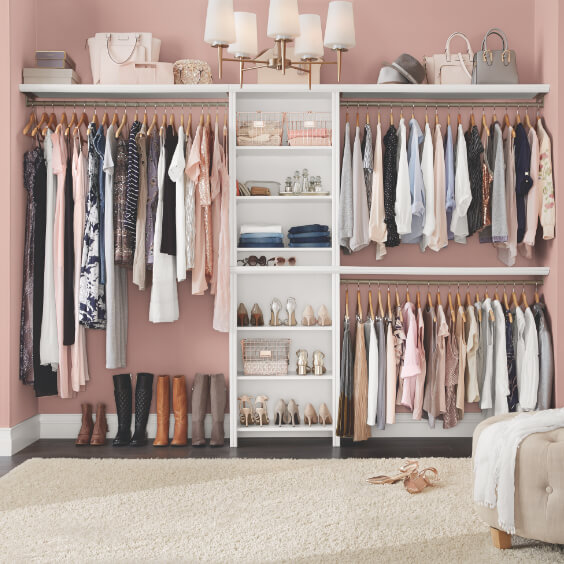
The next step is installing some form of closet organization. Figuring out the right closet storage solutions for your particular space can be challenging. Luckily, there are tons of great options for closet storage solutions, including closet systems, but most people can get away with installing a few budget-friendly closet organizers.
Step #5: Bring in Closet Storage Solutions
Closet storage solutions aren't going to create more space in your closet; however, closet organizers, storage solutions, and closet systems can help to make more storage space accessible to you. Examples:
- A step stool will make it easier for you to reach the top shelves of your closet.
- A double hang will make better use of horizontal storage space in the closet.
- An over-the-door shoe rack can turn your door into the perfect place to store either shoes, accessories, or both.
You might be tempted to throw your hands up, pull out your credit card and buy an expensive closet system. Don't do this. Measure the space, asses what you already have, and then plan your closet accordingly. Buy only what you need to store your clothes, and re-purpose what you already own, if possible. Small bookcases, cubbies, and baskets are great for storing handbags, shoes, accessories, and gym clothes.
Finally, don't forget to measure a space three times before buying a new storage item. Nothing is worse than carting something home and finding it's just a smidge too wide.
Step #6: Organize Your Clothes, Shoes, and Accessories
This is where you put everything back together in a way that makes sense to you, utilizes all of your available space, and is attractive enough to motivate closet maintenance. Think about where it makes sense to store each category of clothing and then think about the easiest spots to reach in your closet.
- Group like with like: Gather belts, sweaters, long-sleeve shirts, work pants, dresses, button-down shirts, jeans, shorts—you get the idea—and decide the best place to store each item as a group (i.e. hang pants in closet, fold and stack sweaters in a bureau). Working in groups of items will help you figure out how much space you need and the best way to store each type of item.
- Properly utilize prime real estate: Reserve the front and middle of your closet for clothes you wear most often. If you have to get dressed for work each morning at 6 a.m., make sure your work clothes are at the front of your closet. Lesser-worn items like formal wear and out-of-season should be stored toward the back and on the upper shelves.
- Tuck away your least-used items: Use the very top of your closet for out-of-season items and stuff you only wear a few times a year, such as Halloween costumes and super-fancy shoes.
Accessories and shoes should be stored separately from your clothing (in other words, don't lump scarves in with sweaters), but keep the prime real estate rule in mind. If you wear a pair of shoes all the time, don't store them in the back of your closet.
Step #7: Maintaining Your Newly Organized Closet
While this isn't an immediate step, it's an important step in the entire process of organizing and maintaining your closet. The more often you work on closet maintenance, the less time it will take. Go through your closet and complete a quick makeover (or make-under) once a month, and tackle the full re-organization process twice a year.
Make it easy on yourself by following a cleaning schedule, either by season, by date (such as your birthday or New Year's) or by event. In other words, the next time you can't find an important piece of clothing, that's a good sign you need to re-organize your closet.